

- The Cost of Developing a Careem Clone – Appysa Technologies
- Cost Comparison: Custom Development vs. White-Label Script
- Inside the Tech Stack: Building for Infinite Scale
- Premium Features Your Careem Clone Script Must Include
Want to launch a ride-hailing startup in MENA or South Asia? Learn the true cost to build a Careem clone app and how our white-label script saves you thousands.
The Cost of Developing a Careem Clone – Appysa Technologies
Rental Software Rental Script
Classified Software Classified Script
Craigslist Clone
Taxi Booking Software Taxi Booking Script
Lyft / Grab Clone
Solutions Rental Solutions Vacation Rental Script
Car Rental Script
Boat Rental Script
Hotel Booking Script
Space Rental Script
Classified Solutions Jobs Classified Script
Cars Classified Script
Pets Classified Script
Services Digital Marketing
Launching a ride-hailing and multi-delivery startup in the MENA (Middle East and North Africa) or South Asian region is one of the most lucrative tech opportunities available today.
With Careem dominating over 70 cities across 10 countries, local entrepreneurs are asking the logical next question: How much does it cost to build a Careem clone app, and how can I launch it affordably without breaking the bank?
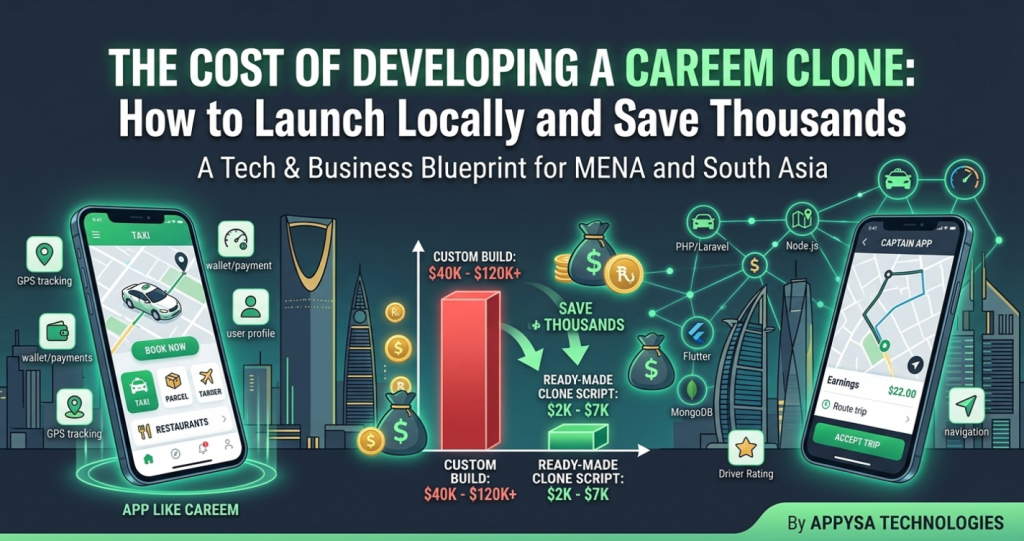
Building a custom platform completely from scratch can easily exceed $40,000 to $120,000+ and take up to a year of development. For a new startup, that is a massive burn rate before you even book your first passenger. However, by leveraging a ready-made, white-label Careem clone script, you can deploy a premium platform in a matter of weeks for a fraction of that cost.
This comprehensive guide breaks down the true cost of development, the modern tech stack behind a scalable architecture, essential features your software must possess, and exactly how to save thousands on your launch.
Cost Comparison: Custom Development vs. White-Label Script
Let’s look at the numbers cleanly. The table below highlights the drastic price and time-to-market differences between hiring a software agency to build an app from the ground up versus deploying a pre-built, customizable enterprise software solution.
Development Factor Custom Development (Scratch Build) Ready-Made Careem Clone Script
Estimated Cost $40,000 – $120,000+ $2,000 – $7,000 (One-time license)
Time to Market 6 to 12 Months 1 to 3 Weeks (Rapid deployment)
Development Team UI/UX Designers, iOS/Android Leads, QA Teams, Project Managers 1-2 Setup Engineers for white-labeling
Risk Factor High (Bugs, scope creep, delayed timelines) Low (Pre-tested, market-validated source code)
Inside the Tech Stack: Building for Infinite Scale
If you want your platform to run smoothly when thousands of riders and captains log on simultaneously, your technical foundation must be rock-solid. A cheap, poorly coded script will crash under load. To prevent this, our advanced taxi booking infrastructure utilizes a high-performance, modern framework designed for rapid processing and real-time synchronization.
Premium Features Your Careem Clone Script Must Include
To effectively compete with regional giants, your platform cannot just be a simple point-A to point-B taxi script. It needs to offer premium, diversified services that maximize revenue per user across your operations.
1. Expanded Booking & Travel Choices
Instant & Scheduled Rides: Let users hail a car immediately or schedule an executive ride for an upcoming flight later in the week.
Outstation Travel: Allow users to book comfortable longer-distance, inter-city journeys directly through the application with customized baseline pricing rules.
Rental Packages: Users can rent a vehicle and driver by the hour with destination management, allowing multiple stops seamlessly.
2. High-Margin B2B and Corporate Offerings
Corporate Rides: Employees can register their corporate IDs. When booking a business trip, the company pays directly, and automated tax invoices are compiled for accounting.
On-Demand Parcel Solutions: Transform your ride-hailing fleet into a last-mile courier network instantly. Enable users to send documents or retail packages with real-time tracking.
3. User-Centric Convenience Tools
In-App Wallet System: Users can securely link credit cards or top up a digital wallet using local payment systems for frictionless, cashless transactions.
Instant Chat & VoIP Calling: Riders and captains can communicate via an encrypted, secure in-app system to coordinate pickups without exposing private phone numbers.
Emergency SOS Safety Alerts: Passengers can instantly hit a dedicated SOS panic button, broadcasting live tracking coordinates to emergency contacts and dispatch teams.
Maximizing Profit: Built-In Revenue Generation Models
Your software shouldn’t just run beautifully—it needs to make money. A robust product features multiple built-in monetization tools controlled entirely from your administrative dashboard:
Ride Commissions: Automatically deduct a fixed percentage or variable cut from every trip completed by your drivers before releasing payouts.
Surge Pricing Algorithms: When localized demand outweighs available driver supply (rush hour or heavy weather), fares raise dynamically to maximize your platform’s margins.
Advertisement Banners: Partner with local brands to display targeted banner advertisements within the consumer application screen during active rides.
Cancellation Fees: Charge users a preset cancellation fee if they back out of a ride booking after a specific time window has passed to protect driver investments.
Avoiding the Hidden Costs of Operational Scaling
When designing your budget blueprint, remember that launching the app is step one. To keep your running overhead low, look for software that optimizes third-party service reliance:
Minimize Mapping API Overspend
Real-time navigation can generate massive monthly Google Maps API bills. Look for systems that integrate smart location caching or allow flexible, open-source mapping alternatives to keep server calls to a minimum.
Secure Mobile OTP Aggregation
Every new customer signup requires a secure mobile verification code (OTP). Partnering with regional, localized SMS aggregators will help you scale your verification loops cost-effectively compared to expensive global providers.
Conclusion: Stop Coding From Scratch, Start Launching
If your goal is to build a highly sustainable ride-hailing business, spending months writing basic code lines from scratch is an unnecessary financial drain. Your core competitive advantage isn’t the code itself—it’s your local operational execution, your relationship with drivers, and your targeted marketing strategies.
Investing in a high-performance, enterprise-grade Careem clone app script built on Laravel, Node.js, and Flutter gives you a market-validated product on day one. It lets you allocate your precious capital exactly where it belongs: scaling your brand, onboarding your fleet, and acquiring customers.
Ready to Dominate Your Local Ride-Hailing Market?
We provide premium, white-label taxi booking scripts and super-app platforms designed for modern global scalability.
Explore Taxisa — Ready-Made Taxi Dispatch Script
Launching a ride-hailing business? Taxisa offers complete passenger & driver mobile apps, real-time GPS tracking, and automated dispatch engines.